

Reducing Muscle Loss in Critically Ill Respiratory Patients Through Early Rehabilitation at LTACHs
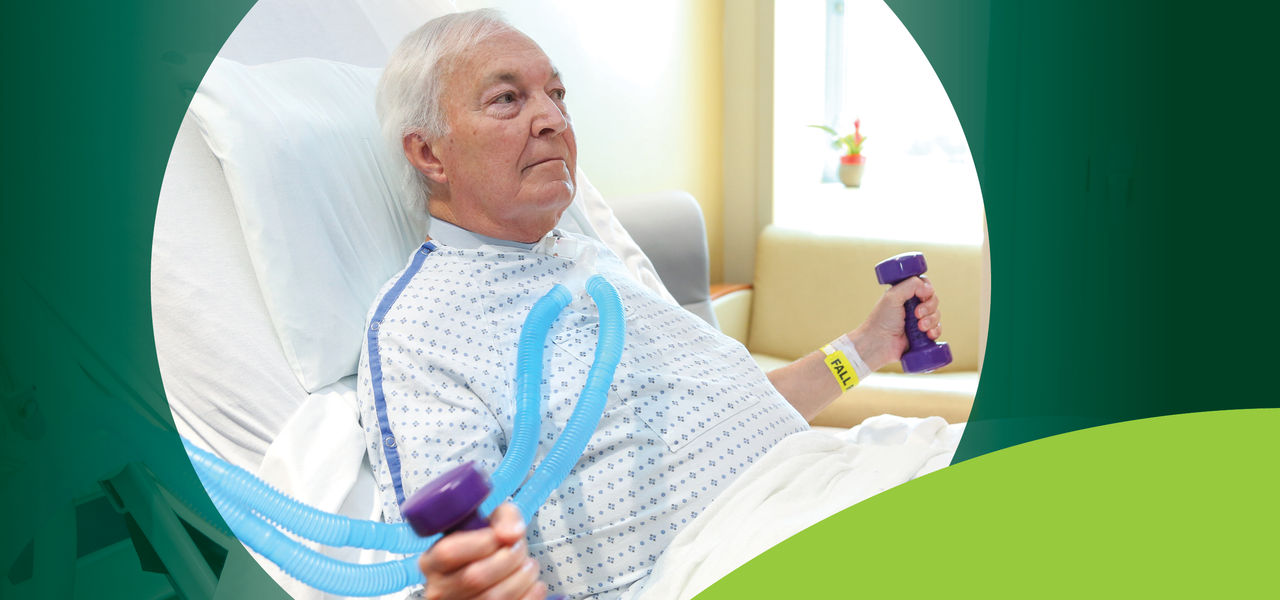
The Importance of Early Rehabilitation
Acute muscle loss is a major concern for respiratory patients in critical care, and early rehabilitation is crucial for combatting it and supporting functional recovery. Long-term acute care hospitals (LTACHs) provide both continued acute care and early rehabilitation for medically complex patients.
Why Muscle Loss Matters
ICU patients lose muscle at a rate of about 2% per day in the first week, and about 50% of critically ill patients develop ICU-acquired weakness1. Patients with critical respiratory conditions are at particular risk: mechanical ventilation and multi-organ failure contribute to inactivity and trigger inflammation and catabolism2, 3, 4. Starting therapy sooner reduces hospital length of stay and time on mechanical ventilation while improving functional outcomes5, 6, 7, which can improve quality of life and reduce the risk of rehospitalization.
The LTACH Advantage
LTACHs allow acute medical treatment, ventilator liberation, and rehabilitation to occur concurrently. Through Kindred’s Move Early Program, patients, including those on mechanical ventilation, begin rehabilitation to the degree they are able, without the three-hours-a-day, five-days-a-week requirement typical of inpatient rehabilitation facilities. Physician-led interdisciplinary teams coordinate care, and therapists join team meetings to build safe plans and ensure patients are medicated for pain or anxiety before sessions. Therapy progresses from stretches and gentle movements in bed to skilled physical and occupational therapy, such as transferring to a chair, walking, and climbing stairs.
Outcomes at Kindred Hospitals
Kindred’s average Hierarchical Condition Category (HCC) score is 8.3, compared with 5.9 for LTACHs nationally and 2.8 for inpatient rehabilitation facilities8, 9. Almost 25% of Kindred patients receiving PT/OT are still on mechanical ventilation10. Despite this complexity, 87% of ventilated patients and 89% of all patients receiving PT/OT reach a high level of mobility (4 or higher out of 8) on the Johns Hopkins Highest Level of Mobility Scale10, 11, and nearly a quarter walk 250 feet or more at discharge.
of ventilated patients receiving PT/OT achieve a high level of mobility*
of all patients receiving PT/OT achieve a high level of mobility*
*As defined by the Johns Hopkins Highest Level of Mobility Scale.
Refer Early. Assess Early. Transfer Early.
Identifying the potential need for LTACH care early can help avoid delays in specialized care and rehabilitation. Connect with our Clinical Liaison team to discuss patient eligibility, care options and the referral process.
References
- Nakanishi N. Intensive care unit-acquired muscle atrophy and weakness in critical illness: a review of long-term recovery strategies. Acute Crit Care. 2025; 40(3):361-372. doi: 10.4266/acc.001450
- Vincent JL, Zambon M. Why do patients who have acute lung injury/acute respiratory distress syndrome die from multiple organ dysfunction syndrome? Implications for management. Clin Chest Med. 2006; 27(4):725-731. doi: 10.1016/j.ccm. 2006.06.010.
- Tobin MJ, Laghi F, Jubran A. Ventilator-induced respiratory muscle weakness. Ann Intern Med. 2010; 153(4):240-245. doi: 10.1059/0003-4819-153-4-201008170-00006.
- Teixeira C, Dexheimer Neto FL, Rosa RG. Multiple organ dysfunction—we must take a closer look at muscle wasting! Rev Bras Ter Intensiva. 2019; 31(2):269-270. doi: 10.5935/0103-507X.20190021.
- Singam A. Mobilizing progress: a comprehensive review of the efficacy of early mobilization therapy in the intensive care unit. Cureus. 2024;16(4): e57595. doi: 10.7759/cureus.57595.
- Wang L, Hua Y, Wang L, Zou X, Zhang Y, Ou X. The effects of early mobilization in mechanically ventilated adult ICU patients: systematic review and meta-analysis. Front Med (Lausanne). 2023; 10:1202754. doi:10.3389/fmed.2023.1202754.
- McWilliams D, Jones C, Atkins G, Hodson J, Whitehouse T, Veenith T, Reeves E, Cooper L, Snelson C. Earlier and enhanced rehabilitation of mechanically ventilated patients in critical care: a feasibility randomised controlled trial. J Crit Care. 2018; 44:407-412. doi: 10.1016/j.jcrc.2018.01.001.
- The Advisory Board. Systems Outcomes Report, Kindred Hospital Medicare IDs, Q1-Q4 2025. https://dag.advisory.com/Reports/PAC_Sys/analysis/2MJ99CDF.
- The Advisory Board. The Post-Acute Care Pathways Explorer: State Average Outcomes, Accessed October 2026. https://dag.advisory.com/MarketExplorer/PAC/National/2M968I7V;
- Kindred Hospital internal data, 10/2025-10/2026
- Johns Hopkins University. Johns Hopkins Highest Level of Mobility (JH-HLM) Scale. Updated July 3, 2014. Accessed October 9, 2026. https://e4center.org/wp-content/uploads/2023/07/Highest-Levelof-Mobility-Scale.pdf