

Kain's Recovery from a Traumatic Brain Injury after a Car Accident
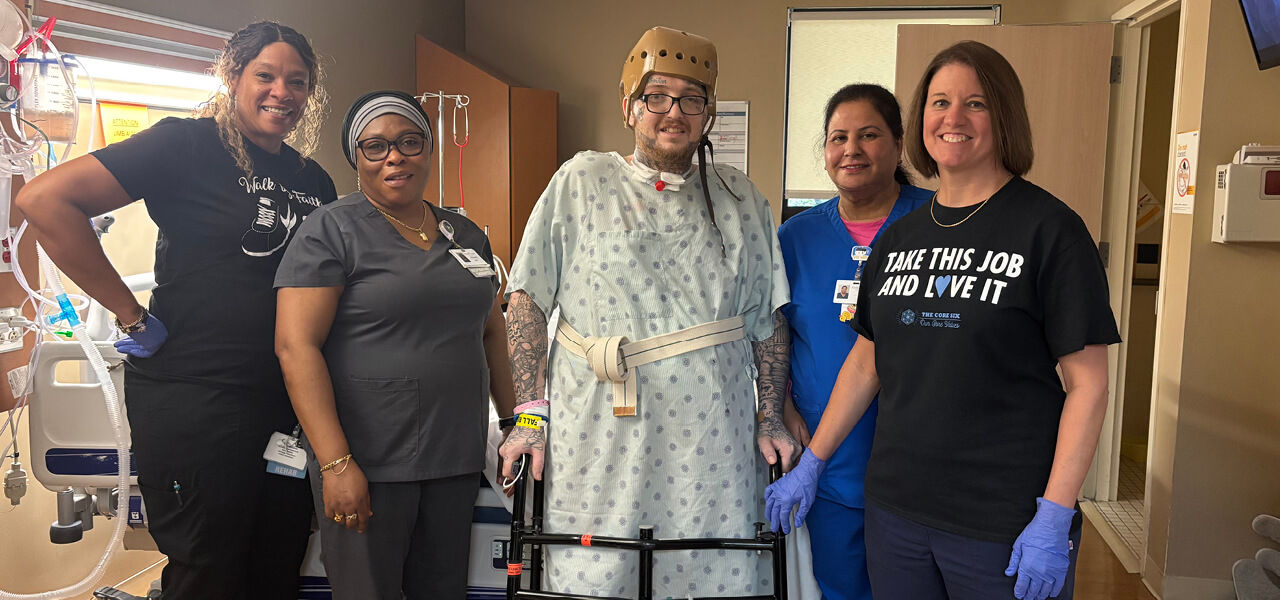
When Kain arrived at Kindred Hospital, he required total assistance for all mobility. After working with his interdisciplinary care team, he could walk 20-25 feet with a walker and was able to be discharged to an acute inpatient rehabilitation facility.
A Patient Success Story from Kindred Hospital Indianapolis
Kain was driving when he had a motor vehicle accident. In the collision, he was ejected six to seven feet. Before arriving at the hospital, he exhibited labored breathing. Following two failed rapid sequence intubation attempts, a laryngeal mask airway was placed. Upon arriving at the emergency department, the laryngeal mask airway was exchanged for a definitive airway via an endotracheal tube.
Imaging revealed a severe traumatic brain injury, characterized by a skull fracture, bilateral acute subdural hematoma, and subarachnoid hemorrhage, necessitating a craniotomy. Additional injuries included multiple facial fractures and multi-level spinal fractures requiring a special back brace. His right ankle fracture needed an open reduction and internal fixation, and was non-weight bearing and supported by a post-op boot. Due to prolonged acute respiratory failure, Kain required a tracheostomy and PEG (feeding) tube placement. Through an interdisciplinary approach at Kindred Hospital Indianapolis – involving teams from respiratory, wound care, dietetics, pharmacy, nursing, and rehabilitation – Kain was medically stabilized. He was successfully weaned to room air, but his trach remains in place pending an upcoming surgery to repair his skull.
Initially, Kain required total assistance for all mobility due to profound loss of strength and his right ankle being non-weight bearing. Adherence to a strict orthotic regimen (a helmet, back brace, and post-op boot) was required. He improved to independence for bed mobility and supervision for transfers and ambulation. He currently walks 20-25 feet with a rolling walker. Following intensive therapy, Kain progressed from a “nothing-by-mouth” nutrition regimen to a regular diet. The back brace has been discontinued, though helmet precautions remain active until his scheduled surgery.
Kain has been discharged to acute inpatient rehabilitation.
Learn more about: Brain Injury & Stroke Care
Take a Personalized Tour
If you’re considering Kindred Hospitals for your loved one, there is no better way to learn about our facilities and offerings than to visit in-person. When you schedule a tour, we can prepare a personalized experience, tailored to your loved one's needs.